Tommy can't sleep. He's afraid of monsters.
You say "monsters aren't real". Nothing changes. You try again. Still nothing.
Tommy isn't the problem. His brain is working exactly as it should at age 3 — when frightened, the line between imagination and reality literally vanishes. Adult logic doesn't reach him. Not because you're doing it wrong. Because nobody gave you a strategy that matches his developmental state.
Telluna gives you that strategy. Built for the 2 to 8-year-old brain you're actually talking to — tonight.
The child is fine. Adult logic is the wrong "tool".
The child isn't broken. They're operating perfectly correctly for their developmental stage. The problem is that parents have been handed adult reasoning for a non-adult brain. "Use your words" "Calm down" "That wasn't nice". Every one of these requires cognitive capabilities that are literally OFF in a 2-5 year old.
Developmental psychology has known this for decades. That knowledge never reached parents — because there was no way to deliver it personally, at 10pm, for this child, tonight.
Telluna doesn't intervene on the child. She upgrades the parent — gives them the exact developmental mechanism for the specific brain they're talking to, at this age, tonight.
That's not a feature. That's a different category.
This isn't the "fix your child" market. That one's crowded.
Calm. Moshi. Headspace for Kids. Sleep stories. Breathing apps. Reward charts. They're all selling the same thing in different packaging: something to do TO the child.
Telluna doesn't fix Tommy. She equips the parent with the exact right approach for the brain they're actually talking to.
The market isn't "parents of difficult children". It's every parent of a 2 to 8-year-old, every night. Because every parent is talking to a developing brain they were never taught to understand. The bedtime struggle isn't the market — it's the entry point. The market is the gap between what parents were given and what actually works.
That gap is universal. It's just never been the product. Until now.
She doesn't give advice. She produces decisions.
Ask GPT what to do when your 3-year-old says "I hate you." It tells you to explain that words hurt — which requires theory of mind she won't develop for two more years. Plausible-sounding. Developmentally wrong.
Telluna resolves 10 developmental dimensions, derives which capabilities are ON and OFF, scores every possible approach against the child's specific situation, and produces a decision — not a suggestion.
The parent sees warmth. The engine produces precision.
One LLM call extracts observable facts. Everything else — dimensional reasoning, capability states, aspect activation, mechanism scoring — is deterministic code on human-curated data. The intelligence is in the logic and the data files, not in the language model. That call will be replaced by a local model. The reasoning was never the LLM's job.
This is the moat. You can't replicate it by prompting GPT better. And it's designed to grow — specialists contribute new mechanisms directly, without touching code. New mechanisms are data, not engineering.
Stories are where we start. Not where we stop.
Every element Telluna produces is built on the same foundation — developmental reasoning that knows this child's brain, this age, this situation.
Tonight's answer. The right mechanism for this child, this night. Not a random bedtime tale — a precision-built story that installs the tool this brain can actually use.
The complete bedtime — not a fixed sequence, but a calculated one. Before the story: whatever transition this child needs to absorb it. Body game or breathing — the RPE knows which, based on age and capability. After: whatever holds the resolution into sleep. Forest scene → forest sounds. Not three random apps — one intelligent sequence that knows why every element is there.
Watch your child becoming over weeks and months. The fears that paralyzed him last month — watch them resolve. Cancelling doesn't mean losing a subscription. It means going blind while your child keeps developing.
Three children, one system, all the connections between them. Sibling dynamics, cross-child patterns, partner alignment — the whole family visible. Not individual children. The system they form together.
Pricing details shared in conversation. Each tier is a wider audience and a different message — not more features for the same person.
Parenting apps × child mental health × family wellness. Three growing markets, one product at the intersection.
The parenting app market is crowded with generic advice. Child mental health is growing at 17-19% CAGR. Family wellness is an emerging category with no clear leader. Telluna sits at the intersection of all three.
B2C Subscription
Stories enters through post-crisis search — parents at their worst moment. Ritual enters through a different door entirely: any parent who does bedtime and wants it smarter. No crisis required. No shame barrier. A replacement decision — three disconnected apps replaced by one that knows why every element is there. That's a 10x larger audience with a 10x easier message.
B2B
Every night, thousands of families generate verified outcome data — which mechanism worked, for which child, at which developmental state. That dataset is what every therapist, educator, and pediatrician needs and nobody has. Professional tools and model access are the next revenue layer, 6-9 months out.
Unit Economics
Projected LTV/CAC of 5-10x at blended ARPU. Journey and Family tiers compound retention and ARPU on top. The business widens with every tier shipped — not just deeper into the same audience, but wider into new ones.
The data flywheel: Intelligence → trust → nightly returns → outcome data → better model → better intelligence. The gap widens with every family. A provider can't enter this loop — they'd need the relationship to get the data, and the intelligence to earn the relationship.
Not a tool. A relationship.
This is what it looks like when a parent uses it tonight:
- Not a chatbot. Not a story generator. Not a book library app.
- A companion who remembers the child, knows their world, and is there at 10pm when no one else is.
- Precision therapeutic stories built for this child's developmental stage — not a generic bedtime tale.
She's there every night — because she needs to be. Every child develops differently, and no parent has time to become a developmental psychologist before tonight.
The need was always there. Now it's delivered. Every night, at scale.
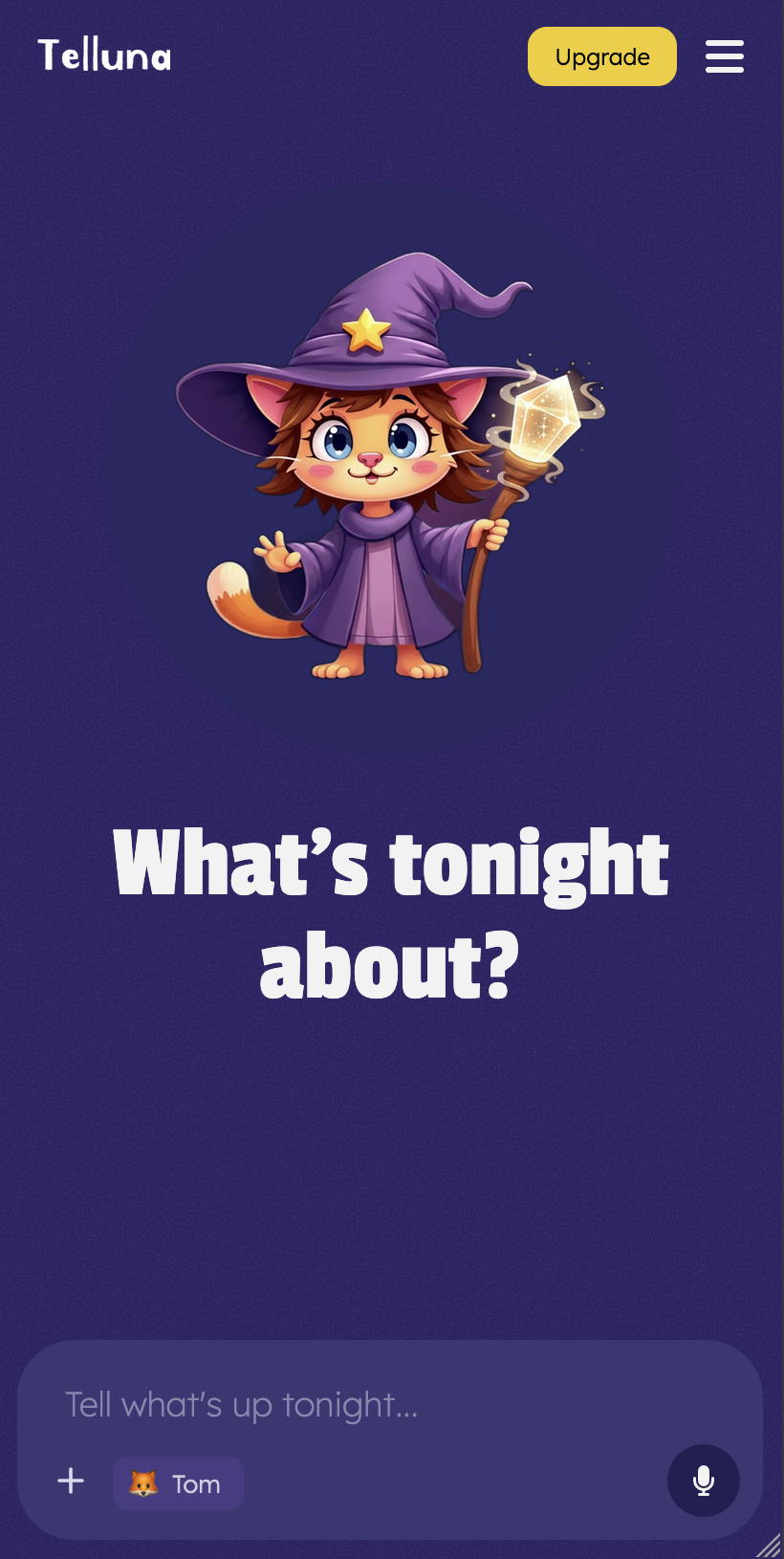
Narrated explanation
Stories tier live. Ritual shipping next. Acquisition engine ready. Seeking fuel.
● Live
- Stories tier — full product (API + chat + insights + stories + audio + subscriptions)
- Reasoning Pipeline Engine (10 dimensions, 30+ mechanisms, traced decisions — one LLM call)
- Data collection live — building the proprietary training dataset
- Content pipeline and acquisition infrastructure ready
→ Roadmap
- 1-2 months: Ritual tier — complete orchestrated bedtime sequence
- 6 months: Journey tier — developmental arc, visible becoming
- Beyond: Family tier — multi-child system intelligence
- Unit economics proven → seed-ready
From engine to proprietary model. Already collecting data.
The RPE reasons through rules. Now we're building the thing that learns from evidence — the DPRM (Developmental Pattern-Response Model).
Not an LLM. Not prompt engineering. A purpose-built neural model that maps behavioral patterns to developmental responses — grounded in capability states, trained on our own verified data.
Data collection is already live. Every pipeline run generates a training example. The dataset that will train this model is growing right now — and no one else has it.
The moat compounds. The pipeline gives us day-one accuracy. The model gives us something that improves with every family and can never be replicated without the same data. Happy to go deeper in conversation.
The foundation is entirely de-risked.
I see where things are going before the market does — and act while the window is open. Telluna is the current one.
Serial founder. Software architect. Behavioral psychology background.
Built the architecture, reasoning pipeline, and initial product solo. The system is live. The content pipeline is running. The core technical risk is gone. Now raising to build the team required to execute the roadmap and scale it.
Pre-seed: $300K. 6 months. Clear milestones.
What it funds
- Team of 4-5 (dev, marketing, content, design)
- Meaningful PPC budget that scales with signal ($5K+/month)
- Specialist collaborations (psychologists, developmental experts)
- Tools, infrastructure, 6 months runway
Milestones
- Month 1-2: Blog live, PPC running, first paying users
- Month 3-4: 200+ paying users, retention data, unit economics visible
- Month 5-6: 1,000+ users, $30K MRR, seed-ready at 10-20x current valuation
Developmental companion for parents. That's not a feature. That's a category.
By 2040, parents will look back and say "how did people raise kids without this?" The need was always there. Now it's possible to deliver it. We're defining what it should be — with a proprietary model underneath that gets smarter with every family.
Stories are where we start. The reasoning engine powers everything that comes after — therapist tools, educator platforms, pediatric integrations. The model predicts what's developmentally happening. That's useful far beyond bedtime stories. The roadmap is ambitious — and we're happy to share it in conversation.
Let's talk.
If something here clicked — let's go deeper.
Prefer email? hello@telluna.app · or find me on LinkedIn